Today is, more so than not to most people, the continuation of a well-appreciated 3 day weekend. (I did not get today off, in case you were wondering) But what I am wondering is, how many people take a moment to remember and reflect on the man who brought about this holiday? I don't, really. Not in the past. The only reason I did today was due to a Fresh Air piece interviewing Michelle Alexander about her most recent book, which now is next on my list of things to read. In short, she brings forth the idea that the contemporary American incarceration system and its so-called "War On Drugs" campaign is but a redesign of the despicable Jim Crow Laws that existed before the Civil Rights era. Bold argument right? She made sense. Disturbingly and unfortunately enough, what she had to say made complete sense.
Listening to her made me think about why we celebrate Martin Luther King, Jr with a national holiday in our time. Do we, as Americans, think we've made leaps and bounds in terms of achieving racial equality? The breakthroughs that occurred during the Civil Rights era were, no doubt, a big step towards gaining equality in the US. But on the other hand, it also merely made explicit racial discrimination illegal while bringing forth new and disguised ways to continue racially discriminatory practices and keep in place a system that has severely disenfranchised African Americans since they were brought here on a boat centuries ago. What's the meaning behind this holiday, then? Why erect a monument honoring Dr King in our nation's capitol? It's almost like saying, well...we haven't achieved your dream yet, and we don't know when we will, or if we ever will, but for the sake of formality we'll put you next to these other monuments representing people and historical events dotting our kids' history textbooks. Just because it seems like the natural thing to do. Not to undermine or belittle the progress that has been made--because we have come a long way--but I think oftentimes we are caught in the misguided hubris of progress. Just because restaurants no longer put up signs prohibiting 'coloreds' means we've made progress? Progress is not progress when a disproportionate number of members from the same racial group continue to be entrapped in a system that allows no way out of a life of drugs, crime, and violence. And apparently, there is no way to move forward when there are idiots like this barring the road.
Showing posts with label Politics. Show all posts
Showing posts with label Politics. Show all posts
Monday, January 16, 2012

Sunday, December 18, 2011
Not a Good Year for Dictators

And I really wonder how North Korea is going to stay as isolated as it has been--if it's even possible to do so now--with the media frenzy and global leadership trying to decide what their next move will be to respond to this. It's all really interesting. Gaah!
Thursday, October 13, 2011
The 99 Percent
There are days when things just come to mind and I have post after post. This is one of those days.
You have to look at this.

I'm fortunate enough to have parents who would ultimately "save" me if I didn't have a job and/or was riddled with debt. Other people are not so lucky. And even my mom and dad, who worked their asses off for over 30 years, have saved up barely enough to retire in decency. They did everything right--worked hard, saved up money like no other (you know the Asian money-saving ethic). I have never, ever seen them spend frivolously. Even so, they've had precarious situations in the past. Failed business. Layoff. Losing money in investments. If my parents have done all this, and are only what I would consider satisfactorily middle class, what about countless other Americans who faced more severe financial and life hardships and obstacles?
Meanwhile, we have our government fighting each other like mad dogs, GOP candidates catering to batshit crazy political parties, and claiming to fight the good fight for the little guy, when in reality they allow these atrocious amounts of money to serve things like "severance pay" for CEOs while attacking regulations that are supposed to keep reckless financial institutions in check. The little guy, who needs the most help, is the one working more than he's sleeping (literally, because the US has the longest working hours of any industrialized country), while simultaneously seeing their income stay the same or decline, seeing his cost of living go up, yet feeling completely helpless about all this because what else can he do but rely on this paycheck to get by? Fed up but voiceless. He wants to stick it to the man, but the man has a monopoly on his lifeline. And the man has allies. They're in the government.
This is why I don't like thinking about the future too much. It dampens the optimism I have left for myself and life because when I am daring enough to look far forward, my positive spirit encounters gloominess.
Listen to those people occupying Wall Street and our city halls. They are speaking for YOU.
You have to look at this.
 |
| This one made me tear up. |
Meanwhile, we have our government fighting each other like mad dogs, GOP candidates catering to batshit crazy political parties, and claiming to fight the good fight for the little guy, when in reality they allow these atrocious amounts of money to serve things like "severance pay" for CEOs while attacking regulations that are supposed to keep reckless financial institutions in check. The little guy, who needs the most help, is the one working more than he's sleeping (literally, because the US has the longest working hours of any industrialized country), while simultaneously seeing their income stay the same or decline, seeing his cost of living go up, yet feeling completely helpless about all this because what else can he do but rely on this paycheck to get by? Fed up but voiceless. He wants to stick it to the man, but the man has a monopoly on his lifeline. And the man has allies. They're in the government.
This is why I don't like thinking about the future too much. It dampens the optimism I have left for myself and life because when I am daring enough to look far forward, my positive spirit encounters gloominess.
Listen to those people occupying Wall Street and our city halls. They are speaking for YOU.
Wednesday, September 28, 2011
The Incredible Shrinking Middle Class and Lost Gen-Ys


I saw these pictures on my FB newsfeed by two different friends.
I finished reading Robert Reich's Aftershock. The main issue he addresses in this book has been on my mind lately, as I watch what's been happening politically and economically in this country. It's a good read that provides an overlooked perspective on why the American economy sucks right now. I'm going to do the book a disservice by giving this overly simple summary, but basically the gist of the argument is that this economic mess was not created by Americans living beyond their means because they had unbridled access to credit (this part I might partially have to disagree with), but because of the widening socioeconomic inequality that has been going on in this country for the past few decades. For the average American worker, wages have increased little, even flatlining, while productivity in the workplace has increased due largely to improvements in technology. Increased productivity benefits CEOs and the companies they run, but not necessarily American workers for the reason stated above. In order to fulfill higher costs of living and counter stagnant wages, Americans spend more time working. Unchanging wages+higher costs of living=Americans saving less to buy a middle class lifestyle. Credit plays a role in this by making things seem more affordable and by creating an illusion of wealth. In 2008 when housing prices began to first level out, then decline, many Americans came to realize they were screwed because families had refinanced their homes in order to gain access to more credit. So now not only did they have mortgage debt, they had consumer debt. And for many people, the most valuable asset--their house--was now worth much, much less. But this entire dynamic is a symptom of the true root of our economic problems, and not the cause. The cause is a set of policies that have come to favor the rich while ignoring, even putting the middle and lower classes, at an economic disadvantage.
We seem to be a society favoring patterns of divergence, and by that I mean not only has our political system come under stress from two increasingly divided ideological camps that have less and less to agree on, our society is splitting off into two groups of haves and have-nots. We resemble an hourglass--the rich people at the top are becoming richer, the poor people at the bottom becoming poorer, and the middle class moving into one of these two categories. Unfortunately, moving downward seems to be a more likely scenario.
The American dream is a joke. I'm very disturbed to see how increasingly difficult it has become for people to make a decent living in this country. We work longer hours, but more and more people hate their jobs. It's almost an anomaly nowadays to find someone who can tolerate their job, let alone like it. We are an anti-middle class country. Look at all this backlash against the public sector and unions. Unions are organizations that are supposed to provide protection to the average working man, yet we allow politicians to dismantle them. Private sector employees shouldn't be looking at the public sector and complaining that people in this sector have overly robust benefits. The private sector should be demanding these types of benefits. We can't have what they have, so they shouldn't have it? Politicians are trying to eliminate social programs where the middle class are the largest group of recipients and prolonging regressive tax policies, like the estate tax, which benefit wealthy Americans. (Reich) Big companies like Procter and Gamble are beginning to develop products and marketing strategies aimed at the upper class because it realizes the middle class--traditionally the most voracious consumers of their products--cannot afford to spend anymore. I'm not lying. This was published in a Wall Street Journal special report, which I didn't read because I would have had to pay for it.
Doesn't this make you shake your head? I think it's wrong to think that as long as you're doing ok then you shouldn't be discontent. It's very dangerous to live in an inequitable society. Countries with high levels of inequality are often the most unstable and violent. This is not about altruism. Even thinking about it in the most self-interested terms, you can't enjoy your own wealth when you're constantly fearful about the angry poor. They will break down your doors, revolt, and cause massive instability. So even if you don't care about the have-nots--maybe you even feel they deserve to be where they are--be discontent. Be discontent that you live in a society where the poor are severely disenfranchised and downtrodden, and the rich live unflinchingly, unsympathetically, in their own little champagne and yacht-filled bubble. If you are the only one well off, then what does it matter?
It's tough to be optimistic, living in a society like this. I try to tell myself it's not hard to be happy, but I guess you can only be happy if your own situation is good and you ignore much of whatever else is going on around you. I'm worried for my generation. We're lost on so many levels, and I think in the long run this economic downturn is going to hit us most adversely. When the debt piles up to a point where we can't not pay it back anymore. When we won't be able to access the sad safety net we call Social Security because we spent our tax dollars paying for the Baby Boomer generation to use it and have nothing left for ourselves. When living with our parents is no longer an option and we're dissatisfied with where we are in life, thinking we would be much bigger than what we've become.
I don't really know what the fix-all to all this is. There probably isn't one. But I can't stop thinking about it.
Saturday, September 10, 2011
Is the American Jobs Act Worth its Price Tag of $447 Billion?
“Business demand is what drives hiring."--Jeffery Braverman, owner of Nutsonline, in recent New York Times article
How do you create demand when people are unemployed? People need jobs to earn income, and you need people to have income in order to increase consumption, and you need consumption in the economy in order for businesses to experience demand. It's all cyclical.
The preliminary verdict on Obama's job creation plan, aka the American Jobs Act, is that it won't make a big dent in the unemployment rate. Cutting payroll taxes might cause employers across industries to "hire at the margins," because the monetary incentive provided just isn't enough...and a substantial number of jobs under the plan would be in the education (i.e. teachers who don't have to be laid off because of government support) and construction/transportation/infrastructure sectors. Unemployed white-collar, college-graduated people are probably looking over this, scratching their head and thinking, what part of the plan addresses my situation? Unless they're willing to become a construction worker (assuming they'll be hired) or have some sort of IT background, have worked or have an interest in the energy sector, or are looking to become certified in a healthcare sector job...three of the industries in the US predicted to grow in the near future.
How do you create demand when people are unemployed? People need jobs to earn income, and you need people to have income in order to increase consumption, and you need consumption in the economy in order for businesses to experience demand. It's all cyclical.
The preliminary verdict on Obama's job creation plan, aka the American Jobs Act, is that it won't make a big dent in the unemployment rate. Cutting payroll taxes might cause employers across industries to "hire at the margins," because the monetary incentive provided just isn't enough...and a substantial number of jobs under the plan would be in the education (i.e. teachers who don't have to be laid off because of government support) and construction/transportation/infrastructure sectors. Unemployed white-collar, college-graduated people are probably looking over this, scratching their head and thinking, what part of the plan addresses my situation? Unless they're willing to become a construction worker (assuming they'll be hired) or have some sort of IT background, have worked or have an interest in the energy sector, or are looking to become certified in a healthcare sector job...three of the industries in the US predicted to grow in the near future.
Friday, September 9, 2011
It Could Happen
Brian: scenario
obama gets nothing done
dismal unemployment until re-election
republican takes both office, house, and senate
dooms day scenario where everyone just gets poorer besides the republicans
likely?
Monday, August 29, 2011
Yoshihiko Noda
Japan has changed Prime Ministers more often these past six years than a beauty pageant contestant changes her outfits during a competition. After Koizumi there hasn't been an individual who's lasted more than a year. Abe, Fukuda, Aso, Hatoyama, Kan, and now very recently elected Yoshihiko Noda. Every time I hear about a new PM being elected I hope that they'll last longer than a year. I imagine it must be difficult getting things done when leadership changes so often. Maybe Noda will last longer, since he seems to take a pretty strong stance on fiscal issues. And I guess since the economy's been basically stagnant for almost two decades...this may be a good thing?? I don't know much about Japanese politics, but it seems like a country that has sort of lost its spirit. Not spirit in the sense of the people's, of course--the tragic tsunami if anything undeniably proved that Japanese people's resiliency and compassion are as strong as they can be--but more like a lacking invigoration from the leadership. A few years ago when I was doing research on China-Japan relations I remember reading a report about how low patriotism was among Japanese youth. And how does Japan form a strong national identity when it has come to depend on the US militarily for its security, and when the rest of the world (especially China) watches it with a wary eye tinted by the legacy of World War II? I think what the perpetual rapid-fire succession of PM after PM indicates is that the Japanese people want a leader who will take a stance, even if it's an unpopular one. To have clear direction, stand up to the rest of the world, and be somewhat of a hardliner. That's what Koizumi was, and there hasn't really been someone like him since then. Or maybe I am wrong because I'm kind of sleepy and changing Prime Ministers every year is something that's ok.
Crossing my fingers for good news this week.
Crossing my fingers for good news this week.
Tuesday, August 16, 2011
The Problem I Have with Social Conservatives and Religion
"Printing more money to play politics at this particular time in American history is almost treacherous, treasonous in my opinion." --Rick Perry referring to Ben Bernanke, on a campaign stop in IowaOk, Mr Perry, don't you think you're being a little melodramatic here? Before you go painting people as unpatriotic infidels, maybe you should think about the fact that there are a good number of Americans who don't believe in the same things you do.
The rise of Christian social conservatives representing the GOP disturbs me. Just the other day I saw a Pew poll saying that the unity between fiscal and social conservatives is getting stronger, based on one common point alone--a deep dislike and distrust of government. Mitt Romney, a centrist Republican, even hailed the Tea Party recently. It's not that I don't like conservatives. When it comes to fiscal conservatives I can't agree with their economic opinions, but I don't have anything against them personally. Social conservatives, I have bigger beef with, because social issues like abortion, gay rights, etc etc are by nature emotional issues. You can't really argue that with data or figures, and those who try to are just being dumb and not convincing anyone. The other thing about super right social conservatives like Bachmann and Perry that I can't accept is their untrammeled application of religious, i.e. Christian, beliefs on politics and governance. As an atheist and a liberal, I can't find a single thing in common with them. And we're supposed to be living in the same country. I don't want someone who I have nothing in common with to be my President. I'm sure there are many, many Americans who feel the same way I do. Just looking at my circle of friends, my family, the people I know, I don't think they would support a presidential candidate with those beliefs. And I know I live in LA, a bubble for liberals. I think if you polled even a Republican from the Carolinas they would not support someone so extreme. Well, if either of them secure the GOP nomination I'll just shake my head and make sure I vote in November. There is NO WAY (knock on wood) that they will make it to the White House. There just isn't. They don't have enough in common with voters like me, and they don't seem like they'll be able to temper themselves to appeal to a broader mass. Anyway...
Not to be too philosophical, but I wonder why people even question whether it's possible for morality to exist without the "guidance" of religion. I totally believe it. I am a living example. I have my own moral compass that evolved and stuck with me free of any religious beliefs. I know not to harm another person, not because the Bible says so, but because to me it's just wrong. I don't need religion to tell me to do good, to be honest, to be righteous. Other people who do good deeds inspire me. My parents inspire me. To be totally, brutally honest, if you're someone who needs religion to tell you what the "right" thing to do is, that is a weak conviction. If you know to do good because of some internal, even unexplained, source your compass will waver much less.
And that is what I really believe, served straight up. No frills, booyah!
Wednesday, August 10, 2011
Ryan Lizza on Michele Bachmann
Now I understand why she's crazy. She believes in ideologues who want to wage the equivalent of a Christian jihadist war on non-believers. So what happens to non-Christians in a Christian-run state where all non-Bible based beliefs are not tolerated? Disturbing."There may “be occasions when Christians are mistaken on some point while nonbelievers get it right...Nevertheless, the overall systems of thought constructed by nonbelievers will be false—for if the system is not built on Biblical truth, then it will be built on some other ultimate principle. Even individual truths will be seen through the distorting lens of a false world view.”--Nancy Pearcey, Total Truth as quoted in in Ryan Lizza's "The Transformation of Michele Bachmann," The New Yorker
Tuesday, August 9, 2011
But She IS Crazy...
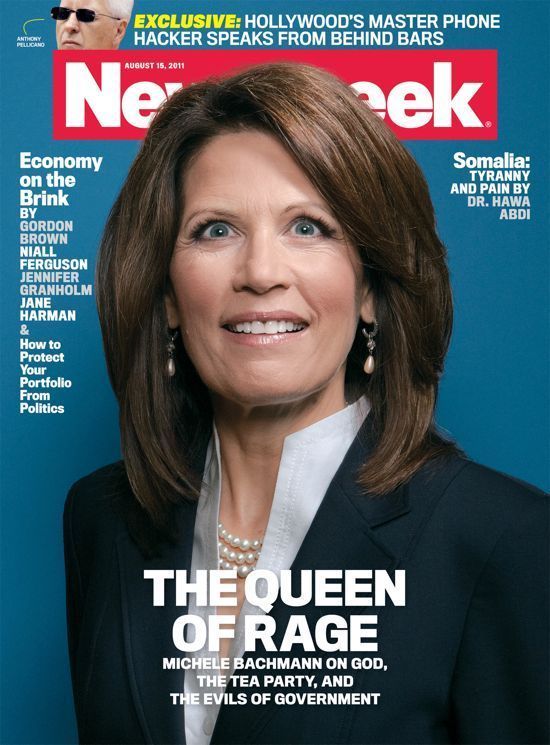
Maybe Newsweek did go a bit overboard, but what can you expect from the media? They're relentless.
As tempted as I am to keep
Tuesday, August 2, 2011
Last Entry on the Debt Ceiling, I PROMISE (For Now)
New York Times: Comparing Deficit Reduction Plans
It's a good graphic illustrating the '11th Hour Plan' and previous proposals.
Two key points I drew from the debt ceiling 'compromise':
It seems like what this bill mostly does is delay the inevitable goal--reducing the deficit. A measure in exchange for securing the more immediate need to raise the debt limit? In a few months, maybe weeks, the second part of the wrangling saga will continue...
I hate talking about 'winners' and 'losers' in this because it characterizes the entire situation for what it should least resemble: a competition. But I can't say it puts Obama in a favorable position when it comes to his reelection prospects, at least for now. Liberal media and the progressive caucus are railing against it as being a concession toward fiscal hawks and more generally, the GOP. Ultra-conservative Republicans can still go back to their constituents and tell them they voted against this bill. They stuck to their guns. If the economy begins recovering I think Republicans will not hesitate to take credit for being the ones to prevent raising taxes.
I honestly can't see this bill stimulating the economy though. At best, the markets will continue to be shaky. Investors will not ignore the elephant in the room, which is US public debt and the ever-present threat of a credit downgrade. At worst, with caps on spending the economic recovery will continue to be weak. How can there be job creation when there is not a Keynesian-like outlet to support hiring efforts? And if come 2012, the economy is still the way it is, Obama and the Democrats are going to be in trouble...
It's a good graphic illustrating the '11th Hour Plan' and previous proposals.
Two key points I drew from the debt ceiling 'compromise':
- 12-person bipartisan Congressional committee to draft a proposal reducing the deficit. A combination of revenue-raising (taxes), tax code-rewriting, and spending cuts can be used. The rest of Congress can vote either to pass or deny it, but no amendments can be made.
- Obama now has, essentially, complete authority to raise the debt ceiling in both phases. Congress can vote down his request but he can still veto it.
It seems like what this bill mostly does is delay the inevitable goal--reducing the deficit. A measure in exchange for securing the more immediate need to raise the debt limit? In a few months, maybe weeks, the second part of the wrangling saga will continue...
I hate talking about 'winners' and 'losers' in this because it characterizes the entire situation for what it should least resemble: a competition. But I can't say it puts Obama in a favorable position when it comes to his reelection prospects, at least for now. Liberal media and the progressive caucus are railing against it as being a concession toward fiscal hawks and more generally, the GOP. Ultra-conservative Republicans can still go back to their constituents and tell them they voted against this bill. They stuck to their guns. If the economy begins recovering I think Republicans will not hesitate to take credit for being the ones to prevent raising taxes.
I honestly can't see this bill stimulating the economy though. At best, the markets will continue to be shaky. Investors will not ignore the elephant in the room, which is US public debt and the ever-present threat of a credit downgrade. At worst, with caps on spending the economic recovery will continue to be weak. How can there be job creation when there is not a Keynesian-like outlet to support hiring efforts? And if come 2012, the economy is still the way it is, Obama and the Democrats are going to be in trouble...
Friday, July 29, 2011
Uh Huh
henrywang228:
you know if for just one day
the united states policy making was turned over to the central committee of the PRC
so much would get done
maybe the halls of congress would smell like smoke
and spit everywhere on the floor
but meh
you know if for just one day
the united states policy making was turned over to the central committee of the PRC
so much would get done
maybe the halls of congress would smell like smoke
and spit everywhere on the floor
but meh
Tuesday, July 26, 2011
Unbridled Privatization? Yes Please, Says Boris the Politician.

Oh my goodness. This graphic came from a New York Times article covering India's rich and the national economy, but what really jumped out at me is the proportion of billionaire wealth that is in the Russian economy. When I think of crony capitalism and shadily acquired wealth Russia is definitely the first country that comes to mind. Russian billionaires hold almost 30% of the entire nation's GDP. My my, what a long way the country has come from communism...
The article itself is interesting too.
Saturday, May 21, 2011
Food as the New Oil in Geopolitics
Lester Brown in Foreign Policy: The New Geopolitics of Food
I don't know how serious the issue really is, considering advocates of political and social issues are true believers in the ideas they stand for and hence will do all they can to sell a powerful argument, but it's still really interesting factual information. Facts are facts, but how impending are the implications is the more important question. As troublesome as Brown makes them out to be? Call me a healthy skeptic. Just as importantly, it should make us think about how, as consumers, we can change our habits for the better.
Awesome Photographic Essay on How Food Explains the World
I don't know how serious the issue really is, considering advocates of political and social issues are true believers in the ideas they stand for and hence will do all they can to sell a powerful argument, but it's still really interesting factual information. Facts are facts, but how impending are the implications is the more important question. As troublesome as Brown makes them out to be? Call me a healthy skeptic. Just as importantly, it should make us think about how, as consumers, we can change our habits for the better.
Awesome Photographic Essay on How Food Explains the World
Monday, May 2, 2011
Irrational Exuberance?
Many Americans are rejoicing in Osama bin Laden's death and seeing it as a significant blow to Al Qaeda's operations. The media is spinning it as pivotal in the war against terror. Political analysts foresee it as being a big chip for Obama's reelection efforts. Basically, the optimism--though guarded somewhat with announcements that the national security team continues to be vigilant against possible retribution by Al Qaeda--is overwhelming. While I think it's definitely a milestone in helping the US in its fight against terrorism, I find myself wondering how important bin Laden has become to the Al Qaeda movement, especially after reading this article by The Economist.
http://www.economist.com/blogs/clausewitz/2011/05/osama_bin_laden&fsrc=nwl
bin Laden was definitely everywhere post-9/11--on the front of newspapers, magazines, TV channels, etc. Everyone was probing into his background, his origins, how he came to be the number one leader of the largest contemporary ideological movement against the West. But as the years passed, as he became more elusive to military agencies, and the search for him became sidetracked by the war in Iraq, his name faded into relative obscurity, with occasional pop-ups of videos he released of himself denouncing the US and the West. I honestly don't think he made a front page news headline in mainstream media recently, until two nights ago when he was dealt his ultimate fate.
Is bin Laden's death really a monumental blow to Al Qaeda? Or are Americans being prematurely celebratory and equating his death to something more than it should be? I'm not an expert on the matter, so what I say shouldn't be taken seriously. But as someone observing the happenings of terrorists that have made headlines in recent years, it seems like radical Islam has become something bigger than Al Qaeda proper. The Underwear Bomber, the tragic train explosion in London a few years ago, the attempted blowing up of Times Square in New York, are all events in recent years that didn't directly have bin Laden's name attached to them. Terrorist acts led by fundamentalists dot the globe--the mainstream media in the US just don't report them. The Philippines, Indonesia, Central Asia, Western Africa--these are all places where I've at least scanned a news article about terrorism being a security issue. It seems like the terrorist network has organically and legitimately taken on a life of its own. It's surpassed Al Qaeda, and if that's the case then it's definitely carried on, with or without bin Laden.
I think it would be really interesting to see what people who belong to the anti-West pro-fundamentalist Islamic movement are thinking about bin Laden's death. I read an article reporting on comments made in internet forums and there's been a whole range of responses. Some were angry and grieving while others thought that bin Laden was replaceable--'it should be easy,' I remember reading.
I can foresee complacency toward the strength and willpower of the terrorist network now that bin Laden--a symbolic figurehead of the West's worst enemy--has been killed. If it's true, I think that might be more dangerous than when he was alive.
http://www.economist.com/blogs/clausewitz/2011/05/osama_bin_laden&fsrc=nwl
bin Laden was definitely everywhere post-9/11--on the front of newspapers, magazines, TV channels, etc. Everyone was probing into his background, his origins, how he came to be the number one leader of the largest contemporary ideological movement against the West. But as the years passed, as he became more elusive to military agencies, and the search for him became sidetracked by the war in Iraq, his name faded into relative obscurity, with occasional pop-ups of videos he released of himself denouncing the US and the West. I honestly don't think he made a front page news headline in mainstream media recently, until two nights ago when he was dealt his ultimate fate.
Is bin Laden's death really a monumental blow to Al Qaeda? Or are Americans being prematurely celebratory and equating his death to something more than it should be? I'm not an expert on the matter, so what I say shouldn't be taken seriously. But as someone observing the happenings of terrorists that have made headlines in recent years, it seems like radical Islam has become something bigger than Al Qaeda proper. The Underwear Bomber, the tragic train explosion in London a few years ago, the attempted blowing up of Times Square in New York, are all events in recent years that didn't directly have bin Laden's name attached to them. Terrorist acts led by fundamentalists dot the globe--the mainstream media in the US just don't report them. The Philippines, Indonesia, Central Asia, Western Africa--these are all places where I've at least scanned a news article about terrorism being a security issue. It seems like the terrorist network has organically and legitimately taken on a life of its own. It's surpassed Al Qaeda, and if that's the case then it's definitely carried on, with or without bin Laden.
I think it would be really interesting to see what people who belong to the anti-West pro-fundamentalist Islamic movement are thinking about bin Laden's death. I read an article reporting on comments made in internet forums and there's been a whole range of responses. Some were angry and grieving while others thought that bin Laden was replaceable--'it should be easy,' I remember reading.
I can foresee complacency toward the strength and willpower of the terrorist network now that bin Laden--a symbolic figurehead of the West's worst enemy--has been killed. If it's true, I think that might be more dangerous than when he was alive.
Wednesday, April 27, 2011
Wow, Obama was Born in the US? What a Surprise!
http://www.slate.com/id/2292303
Wow, Donald, congratulations. If you do decide to run for the presidency at least you can use this as proof that you CAN get things done, in comparison to the equally efficient way you manage your hotels and properties. Oh wait...
http://www.whitehouse.gov/sites/default/files/rss_viewer/birth-certificate.pdf
I think it's weird to have such a private document floating around the internet, accessible by anyone, but I guess when you're the President of the US nothing escapes the public eye.
Now that the "birthers" can't harp on this issue, what's going to be the next target of attack? The citizenship status of Obama's dad? His qualifications to attend Ivy League institutions? Idiots.
Wow, Donald, congratulations. If you do decide to run for the presidency at least you can use this as proof that you CAN get things done, in comparison to the equally efficient way you manage your hotels and properties. Oh wait...
http://www.whitehouse.gov/sites/default/files/rss_viewer/birth-certificate.pdf
I think it's weird to have such a private document floating around the internet, accessible by anyone, but I guess when you're the President of the US nothing escapes the public eye.
Now that the "birthers" can't harp on this issue, what's going to be the next target of attack? The citizenship status of Obama's dad? His qualifications to attend Ivy League institutions? Idiots.
Thursday, April 14, 2011
A Dummy's Understanding of the US Federal Budget Situation
There’s currently all this buzz about the budget deficit and government shutdowns in the US. I hear it on the radio, I read it in the news, but I have to be entirely truthful and say my understanding of the whole situation is rather superficial. So in an attempt to be an educated citizen, I decided to look into it a bit more, despite knowing I would be taking precious time away from my thesis. I hope it’ll be worth it. I think it will, because what happens to the budget now and in the future will have a huge impact on my generation: as taxpayers, and as recipients of healthcare, social security (if it’s still around by the time we retire), and other potential government benefits.

The Economist released a rather impressing (not to be confused with impressive) visual of the US budget deficit today. The IMF reported this data. Currently it looks like our budget deficit is about 11% of GDP, while gross government debt as a percentage of GDP stands at almost 100 percent. The latter statistic is pretty scary, but I guess when compared to Japan we’re in a much less severe position. On the other hand, the forecast for reducing out deficit to GDP ratio looks rather optimistic. I guess if a solid plan to reduce the deficit is passed and implemented, we can get the ratio down to a little under 8% by next year. But, to use the old cliché, the devil is in the details. I’m more interested in how exactly the deficit will be cut, so I did a little novice research.
Both parties, Democrat and Republican, are adamant about cutting the budget deficit. They just can’t agree on where the cuts should be made. And this is where the groundswell for partisan politics come in, i.e. the finger-wagging and blame-placing. It might help to first look at what our current federal budget looks like.

The creator of this pie chart took the data from the Congressional Budget Office. It is pretty striking that healthcare constitutes almost a quarter of all spending. With social security and defense spending taking up another 2/5 of the federal budget, I’m assuming everything else is lumped under the category of “discretionary spending.” Everything else, as in education, transportation, environment, urban development, veterans’ benefits, state/foreign affairs, etc is under this one category, which constitutes also about 1/5 of the most recent budget spending report. (The percentage has hovered between 12 to 20 percent in recent past years.)
Here’s a link to a nifty little visual the Office of Management and Budget at the White House put out about what the composition of federal spending looks like.
http://www.whitehouse.gov/omb/budget
So it would make sense to make cuts where it would really make a dent right? I mean, if you’re proposing cutting something that constitutes 1% of the entire budget, that’s like throwing dollars into a trillion-dollar vault. It’s not really going to make a difference, and it won’t aid in the goal of reducing the deficit in the long run.
The next step I took was to see what both parties are proposing cutting. This is the schematic I’ve come to after doing some research. The items are presented in descending order of proposed amount to be cut. In other words, the top of the list is where the largest amount of cuts would be made.

I got this information from respective publications released by the Office of Management and Budget at the White House and the House Budget Committee.
What the Republicans are not cutting, that the Democrats are in favor of, are taxes that were extended to households and individuals during the “Bush tax cut era.” The Republicans are in favor of extending these tax cuts. This is significant because if the tax cuts were allowed to expire it would free up revenue. The counterargument is that these tax cuts are necessary to put more spending power in the hands of Americans and encourage economic growth. If we get our budget in order and eliminate unnecessary spending, argues Republicans, we wouldn’t even be discussing the option of getting rid of tax cuts.
This chart is an oversimplification. Yes, these are the areas that both sides respectively are promoting to cut, but it doesn’t reflect the rationale behind them. Many Republicans are motivated by the need to eliminate “wasteful spending” and “earmarks” (do those buzz words ring to you?), or at least it is claimed. Democrats do not want to make substantial cuts to social spending, so programs like Medicare, Social Security, and education in general are receiving similar levels of funding. Both generally agree that defense spending needs to be kept at similar levels—Democrats are willing to dig a little deeper in favor of cuts.
I’m not a super economist so even after reading about this I’m not sure what to make of it. I’m in favor of spending as long as it goes toward social services that will help average Americans, and I’m willing to use my tax dollars for that purpose. What I don’t have is faith in the unwieldy, politicized bureaucracy to allocate revenue in an efficient way. So Paul Ryan’s plan to reduce the size of the government might address this issue, and if it does then I’m for it. I also agree that the deficit needs to be kept under control, because these levels of spending are unsustainable. And when it comes time to pay back what we owe, chances are that we—this current generation entering the workforce—will all still be alive to see our hard earned dollars going to pay back our creditors. And if we’re all complaining about how high taxes are now…imagine that multiplied by a few times over. It doesn’t take a dummy to realize that in times of economic hardship, the taxpayers always come to the rescue, whether they want to or not. In the meantime, I hope both sides come to a consensus long enough to avoid another government shutdown.

The Economist released a rather impressing (not to be confused with impressive) visual of the US budget deficit today. The IMF reported this data. Currently it looks like our budget deficit is about 11% of GDP, while gross government debt as a percentage of GDP stands at almost 100 percent. The latter statistic is pretty scary, but I guess when compared to Japan we’re in a much less severe position. On the other hand, the forecast for reducing out deficit to GDP ratio looks rather optimistic. I guess if a solid plan to reduce the deficit is passed and implemented, we can get the ratio down to a little under 8% by next year. But, to use the old cliché, the devil is in the details. I’m more interested in how exactly the deficit will be cut, so I did a little novice research.
Both parties, Democrat and Republican, are adamant about cutting the budget deficit. They just can’t agree on where the cuts should be made. And this is where the groundswell for partisan politics come in, i.e. the finger-wagging and blame-placing. It might help to first look at what our current federal budget looks like.
The creator of this pie chart took the data from the Congressional Budget Office. It is pretty striking that healthcare constitutes almost a quarter of all spending. With social security and defense spending taking up another 2/5 of the federal budget, I’m assuming everything else is lumped under the category of “discretionary spending.” Everything else, as in education, transportation, environment, urban development, veterans’ benefits, state/foreign affairs, etc is under this one category, which constitutes also about 1/5 of the most recent budget spending report. (The percentage has hovered between 12 to 20 percent in recent past years.)
Here’s a link to a nifty little visual the Office of Management and Budget at the White House put out about what the composition of federal spending looks like.
http://www.whitehouse.gov/omb/budget
So it would make sense to make cuts where it would really make a dent right? I mean, if you’re proposing cutting something that constitutes 1% of the entire budget, that’s like throwing dollars into a trillion-dollar vault. It’s not really going to make a difference, and it won’t aid in the goal of reducing the deficit in the long run.
The next step I took was to see what both parties are proposing cutting. This is the schematic I’ve come to after doing some research. The items are presented in descending order of proposed amount to be cut. In other words, the top of the list is where the largest amount of cuts would be made.

I got this information from respective publications released by the Office of Management and Budget at the White House and the House Budget Committee.
What the Republicans are not cutting, that the Democrats are in favor of, are taxes that were extended to households and individuals during the “Bush tax cut era.” The Republicans are in favor of extending these tax cuts. This is significant because if the tax cuts were allowed to expire it would free up revenue. The counterargument is that these tax cuts are necessary to put more spending power in the hands of Americans and encourage economic growth. If we get our budget in order and eliminate unnecessary spending, argues Republicans, we wouldn’t even be discussing the option of getting rid of tax cuts.
This chart is an oversimplification. Yes, these are the areas that both sides respectively are promoting to cut, but it doesn’t reflect the rationale behind them. Many Republicans are motivated by the need to eliminate “wasteful spending” and “earmarks” (do those buzz words ring to you?), or at least it is claimed. Democrats do not want to make substantial cuts to social spending, so programs like Medicare, Social Security, and education in general are receiving similar levels of funding. Both generally agree that defense spending needs to be kept at similar levels—Democrats are willing to dig a little deeper in favor of cuts.
I’m not a super economist so even after reading about this I’m not sure what to make of it. I’m in favor of spending as long as it goes toward social services that will help average Americans, and I’m willing to use my tax dollars for that purpose. What I don’t have is faith in the unwieldy, politicized bureaucracy to allocate revenue in an efficient way. So Paul Ryan’s plan to reduce the size of the government might address this issue, and if it does then I’m for it. I also agree that the deficit needs to be kept under control, because these levels of spending are unsustainable. And when it comes time to pay back what we owe, chances are that we—this current generation entering the workforce—will all still be alive to see our hard earned dollars going to pay back our creditors. And if we’re all complaining about how high taxes are now…imagine that multiplied by a few times over. It doesn’t take a dummy to realize that in times of economic hardship, the taxpayers always come to the rescue, whether they want to or not. In the meantime, I hope both sides come to a consensus long enough to avoid another government shutdown.
Monday, December 13, 2010
Richard Holbrooke: 1941-2010 | FP Passport
Richard Holbrooke: 1941-2010 | FP Passport
A pivotal figure in US foreign policy has passed away. May he rest in peace.
A pivotal figure in US foreign policy has passed away. May he rest in peace.
Monday, November 29, 2010
The Cat's Out of the Bag
Whoo, Wikileaks has now given me new source of information for research! But seriously, what do people expect? International politics is not a saintly game. You can call US foreign policy what you want--deceiving, hypocritical, corrupt--but no country escapes such accusations. This huge leak just confirms what any person with common sense has known all along.
Sunday, November 28, 2010
Speak Softly and Share the Big Stick
“We have moved from the cold war era of bipolar reality through the brief bubble of sole superpower unilateral fantasy into a world of a new multipowered system which requires old-fashioned balance-of-power diplomacy,” Mr. Rothkopf said. The result, he said, may be that “all of a sudden, the old cobweb-infested State Department is more important than it’s been in many, many years.”
--David Rothkopf, author of Running the World: The Inside Story of the National Security Council and the Architects of American Power, in a recent New York Times article
I wonder what American society will be like if in our lifetime the authority of the most powerful country in the world dissolves. The what-says-what-goes attitude of the US has fostered a society of people who can afford to not preoccupy themselves with foreign affairs and be educated about global issues. Can we ordinary Americans afford to be ignorant about issues outside of our borders--issues that are integral to our country's welfare--the day we're no longer the hegemon of the pecking order? Two things might happen. One is that there will increasingly be a discord between what the American public wants, i.e. demands made on the domestic level, and what the US needs to do on the international front. It's undeniable that American unilateralism is being increasingly challenged, whether it's from push or pull factors. This could very well make multilateralism the most viable way of conducting diplomacy in the foreseeable future, especially if the US is looking to slow down the ability for unilateral decision-making by a few other unnamed rising powers in the world. So then what? What if the public doesn't enjoy this seemingly compromising way of the US managing international affairs, especially if it may adversely affect the economic and socio-political situation at home?
The other thing that might happen is it may compel a generation of Americans to become interested in international affairs. Maybe we'll start asking questions, become interested in world history, educate ourselves on what past and present US foreign policy has been..we'll start talking about these things and caring...and maybe then the local media won't relegate foreign affairs news to a 2 minute clip or a blurb. It'll be...a revolution! Probably? Maybe? Perhaps?
I'm devastated that the New York Times is going to require a paid subscription for its services next year. Where am I going to turn to for free, informative, unabashedly liberal-slanting news? I don't want to read things outside of my worldview--it's a highly discomfiting feeling.
--David Rothkopf, author of Running the World: The Inside Story of the National Security Council and the Architects of American Power, in a recent New York Times article
I wonder what American society will be like if in our lifetime the authority of the most powerful country in the world dissolves. The what-says-what-goes attitude of the US has fostered a society of people who can afford to not preoccupy themselves with foreign affairs and be educated about global issues. Can we ordinary Americans afford to be ignorant about issues outside of our borders--issues that are integral to our country's welfare--the day we're no longer the hegemon of the pecking order? Two things might happen. One is that there will increasingly be a discord between what the American public wants, i.e. demands made on the domestic level, and what the US needs to do on the international front. It's undeniable that American unilateralism is being increasingly challenged, whether it's from push or pull factors. This could very well make multilateralism the most viable way of conducting diplomacy in the foreseeable future, especially if the US is looking to slow down the ability for unilateral decision-making by a few other unnamed rising powers in the world. So then what? What if the public doesn't enjoy this seemingly compromising way of the US managing international affairs, especially if it may adversely affect the economic and socio-political situation at home?
The other thing that might happen is it may compel a generation of Americans to become interested in international affairs. Maybe we'll start asking questions, become interested in world history, educate ourselves on what past and present US foreign policy has been..we'll start talking about these things and caring...and maybe then the local media won't relegate foreign affairs news to a 2 minute clip or a blurb. It'll be...a revolution! Probably? Maybe? Perhaps?
I'm devastated that the New York Times is going to require a paid subscription for its services next year. Where am I going to turn to for free, informative, unabashedly liberal-slanting news? I don't want to read things outside of my worldview--it's a highly discomfiting feeling.
Subscribe to:
Posts (Atom)